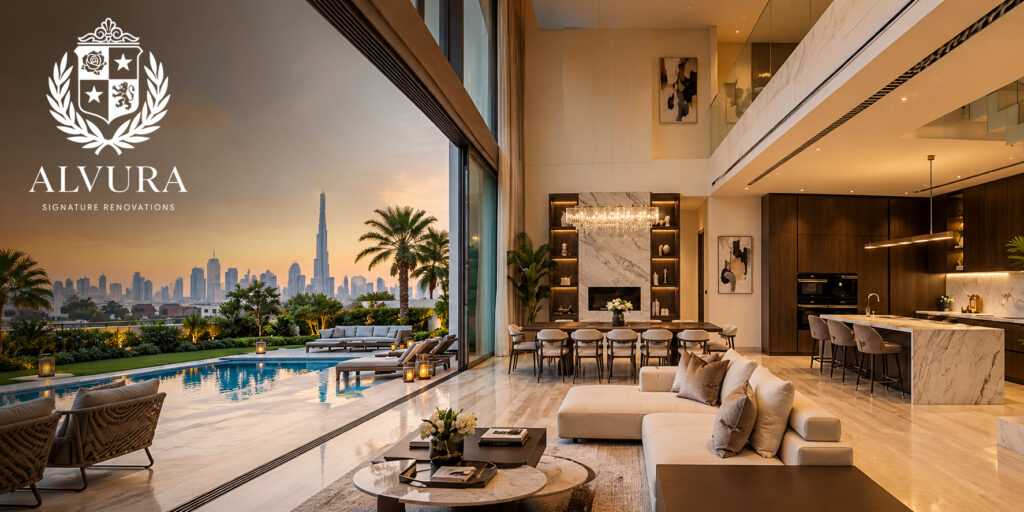
There is a moment, usually around 7 in the evening, when you find out whether your villa was designed well. The light drops, the air conditioning hums in the background, and you either feel the house exhale around you or you notice every harsh spotlight, every glossy surface and every cabinet door that does not quite line up.
That feeling is what quiet luxury comes down to. It comes from hundreds of decisions about stone, light and craftsmanship that most visitors never consciously register, rather than from a style copied off a mood board.
If you are planning villa design in Dubai, for a forever home in Emirates Hills or an investment property in Dubai Hills, this guide explains what quiet luxury involves, how to specify the 3 elements that matter most (materials, lighting and joinery), and what to decide before a single wall is touched.
What Quiet Luxury Means for a Dubai Villa
Quiet luxury is a design approach built on restraint, texture and quality rather than visible branding or decoration. In a Dubai villa, that means moving away from the heavy gold, high gloss finishes and cluttered detailing that defined an earlier era of luxury interiors, and towards calm, layered spaces where the materials do the talking.
In practice, it comes down to 3 principles:
- Timeless: a scheme that looks as relevant in 10 years as it does on handover day, because it does not rely on a trend.
- Tactile: natural stone, linen, brushed metals and real timber that feel as good to touch as they look.
- Functional: layouts and storage planned around how your household actually lives, making every square foot of built up area (BUA) earn its place.
Quiet luxury is not minimalism for its own sake, and a villa designed this way can be warm and personal, with plenty in it. What it avoids is noise, meaning competing finishes, overlit ceilings and joinery that shouts for attention.
Why Villa Design in Dubai Is a Harder Brief Than It Looks
Dubai villas bring a specific set of challenges that a scheme copied from a London townhouse or a Milan apartment will not survive.
- Light is intense and changes fast. Bright midday glare gives way to a very short dusk, so lighting has to work at every hour, not just in a render.
- The climate is hard on materials. Heat, humidity, dust and constant air conditioning cycles all affect stone, timber and finishes differently.
- Villas are large and often similar. In communities where many homes share the same layout, the quality of the finish is frequently what sets a villa apart from its neighbours.
- Approvals shape what is possible. The approvals a project needs depend on the scope of work, the type of property and the master developer, so we check whether developer, Dubai Municipality or DEWA approval applies before work begins.
This is why good villa design in Dubai starts with the building itself, its light, its climate and its approvals, before anyone opens a mood board.
Materials: Where Quiet Luxury Is Won or Lost
Quiet luxury relies on a small number of exceptional materials used with discipline. A common mistake is choosing too many. A palette of 3 or 4, repeated throughout the villa in different forms, creates the calm, cohesive feel that people associate with high end homes.
Natural stone: Italian marble and honed finishes
Italian marble remains the benchmark for luxury interiors, but how it is specified matters as much as the stone itself.
- Honed over polished: a honed or softly brushed surface reads as more refined and hides everyday wear better than a mirror polished one.
- Continuity of veining: book matching slabs and planning the layout of every cut makes a wall or island look like a single piece of stone rather than a collection of tiles.
- Slab and joint planning: the fewer the joints, and the more precisely they are aligned, the more expensive the result looks. This is where installation accurate to the millimetre matters.
- Sealing and maintenance: marble is porous. A proper sealing plan, agreed before installation, protects it in kitchens and bathrooms.
Wide plank European oak
Wide boards with a natural, low sheen finish add warmth that stone cannot. In a climate controlled largely by air conditioning, the construction of the board matters: stable, well engineered flooring installed over a properly levelled substrate will perform far better than a cheaper product laid on an uneven slab. Levelling is not glamorous, but it is the reason a floor still looks flat and quiet years later.
Hand applied microcement
Microcement gives walls, bathrooms and sometimes floors a continuous finish with no grout lines, much like the walls of a gallery. It is one of the clearest expressions of quiet luxury and one of the least forgiving, because the result depends entirely on the substrate preparation, the skill of the applicator and the sealing system. Movement joints and waterproofing need to be planned with the structural and MEP teams, not added afterwards.
Linen, brushed metals and soft textures
The finishing layer is what stops a restrained scheme feeling cold. Brushed brass or bronze hardware, linen upholstery, textured wall finishes and natural fibres add depth without adding clutter. These are also the elements most visible to guests, so consistency of finish across door handles, tapware and fittings is worth specifying early.
Lighting: The Layer People Feel Without Noticing
If materials are what you see, lighting is what you feel. The fastest way to undermine a beautiful interior is to light it badly, and the most common mistake in luxury villas is relying on a grid of recessed downlights.
Quiet luxury lighting is designed in layers:
- Architectural lighting: cove lighting, shadow gaps and concealed linear LEDs that wash walls and ceilings with soft light and define the volume of the room.
- Functional task lighting: carefully placed light for kitchen worktops, dressing rooms, reading corners and bathrooms, where you actually need it.
- Statement pieces: a hero chandelier, sculptural pendant or standout floor lamp that gives each key space a focal point.
A few principles separate a professionally designed scheme from a decorated one:
- Consistent colour temperature. Warm, consistent white light across the villa feels calm. Mixed tones feel unintentional.
- High quality fittings and dimming. The ability to move from bright daytime mode to a low evening mood is what lets a space serve different moments of the day.
- Control as well as fittings. Scenes that change a whole room at once matter more than any individual fixture.
- Planning before ceilings close. Cove details, ceiling drops and cable routes must be resolved with the structural and MEP plan. Retrofitting concealed lighting is difficult and expensive, and electrical changes need DEWA approval.
This is also why lighting design should happen alongside the architectural stage rather than after it.
Joinery: Where a Villa Feels Expensive or Doesn’t
Joinery is often where the gap between a design and a finish becomes obvious. It is also where quiet luxury is most unforgiving, because restrained detailing leaves nowhere to hide poor work.
The pieces that define a luxury villa include:
- Hidden kitchen pantries behind flush doors, so the kitchen stays calm and uncluttered.
- Floor to ceiling library walls and display niches that add architecture to a living room.
- Walk in dressing rooms planned around real wardrobes, not generic layouts.
- Built in media, bar and study units that look like part of the building rather than furniture.
What separates good joinery from great joinery:
- Shop drawings for everything. Every cabinet, socket and light switch should be drawn and agreed before manufacturing begins, so errors are caught on paper rather than on site.
- Quality carcasses and hardware. Soft close mechanisms, quality hinges and runners are what you feel every day. Cheap hardware fails first.
- Tight tolerances and consistent reveals. Even gaps and flush finishes are what quiet luxury depends on.
- Materials suited to the climate. Humidity and temperature swings can move poorly specified boards, so the construction and finish need to be chosen for Dubai conditions.
British standard cabinetry, precisely fitted, is what turns a good design into something that still feels right after a decade of daily use.
The Decisions to Make Before the Build Begins
Most regret in a villa project does not come from a bad idea. It comes from a good idea that was decided too late. Before construction starts, these should all be settled:
- The layout and structure. Open plan conversions, double height spaces and large openings affect the structure, and should be resolved through structural work planning, not discovered mid build.
- The material palette. Samples approved in the actual light of your villa, not just on a screen.
- The lighting plan and controls. Fixed on drawings before electrical first fix.
- The joinery package. Fully drawn, with hardware and finishes confirmed.
- The approvals. Developer NOCs, authority permits and DEWA sign off, handled before work begins rather than discovered as delays.
High fidelity 3D visualisation and VR walkthroughs are worth using here. Seeing your scheme in a realistic model before materials are ordered is far cheaper than changing your mind in the finished room.
How to Choose a Villa Design and Renovation Partner
If you are comparing a home renovation company in Dubai to deliver a quiet luxury villa, the questions you ask at the first meeting reveal a great deal:
- Do design and construction sit under 1 accountable team, or will you coordinate several companies?
- Will you receive a fixed, itemised proposal before work begins, rather than a headline figure that grows through variations?
- Are shop drawings produced for joinery and electrical points before anything is built?
- Who handles authority and developer approvals, and are they managed in house?
- How will you see progress if you are overseas?
At Alvura, villa design, structure, interiors and landscaping are managed as a single design and build project under British site management, with a private dashboard that shows budgets, schedule and daily site photography from anywhere in the world. You can see how this works across a full villa renovation in Dubai, or explore our approach to home renovation in Dubai more broadly.
FAQs
1. Can quiet luxury work in a Dubai villa without feeling cold or minimal?
Yes, and the difference comes down to layering rather than quantity. Dubai villas are large, so rooms need intentional focal points, such as a hero light fitting, a library wall or a considered piece of art, to avoid feeling empty. Think of quiet luxury as editing, where every item left in the room has been chosen for how it feels.
2. How do natural materials like marble, microcement and oak perform in Dubai’s heat, humidity and air conditioning?
Very well if specified and installed correctly, and poorly if they are not. The main risks come from movement and moisture. Temperature and humidity swings between outdoors and heavily air conditioned interiors can cause poorly constructed timber to shift and unsealed stone to stain. The best protection is early specification: materials chosen alongside the structural and MEP plan, rather than late in the process when problems are harder to fix.
3. When should lighting be planned, and what should I decide first?
Lighting should be designed at the same stage as the layout, well before ceilings are built or the electrical first fix begins. Decide the layers first: what will provide soft architectural light (cove lines, shadow gaps), what will serve tasks (kitchen, dressing room, study), and where the hero pieces sit. Then fix the practical decisions: 1 consistent colour temperature through the villa, dimming zones, and the control system that allows scenes for morning, dining and late evening.
4. Is bespoke joinery worth it compared with imported or off the shelf units, and how do I judge quality before installation?
For the spaces you use daily and the details guests see, bespoke joinery is usually worth it because it is built to fit your villa’s exact dimensions, with no filler panels, awkward gaps or compromises around services. It also lets you integrate hidden storage, such as pantries and dressing rooms, that off the shelf units cannot. To judge quality before installation, ask to see the shop drawings and a sample door or drawer with the hardware fitted, and check the reveals and the finish on the edges.
5. Is a quiet luxury scheme too restrained for resale, or will buyers respond to it?
Restraint and resale are not in conflict, provided the finish is excellent. Buyers at the upper end of the Dubai villa market are typically comparing several similar properties, and what separates them is quality they can perceive quickly. The risk lies in underspecifying, where a minimalist scheme is executed with mid range finishes and the lack of detail shows. If resale is part of your plan, concentrate budget on the areas buyers inspect first (entrance, kitchen, principal bathroom, main living space, outdoor entertaining area) and keep personal, highly specific features removable or easy to adapt.